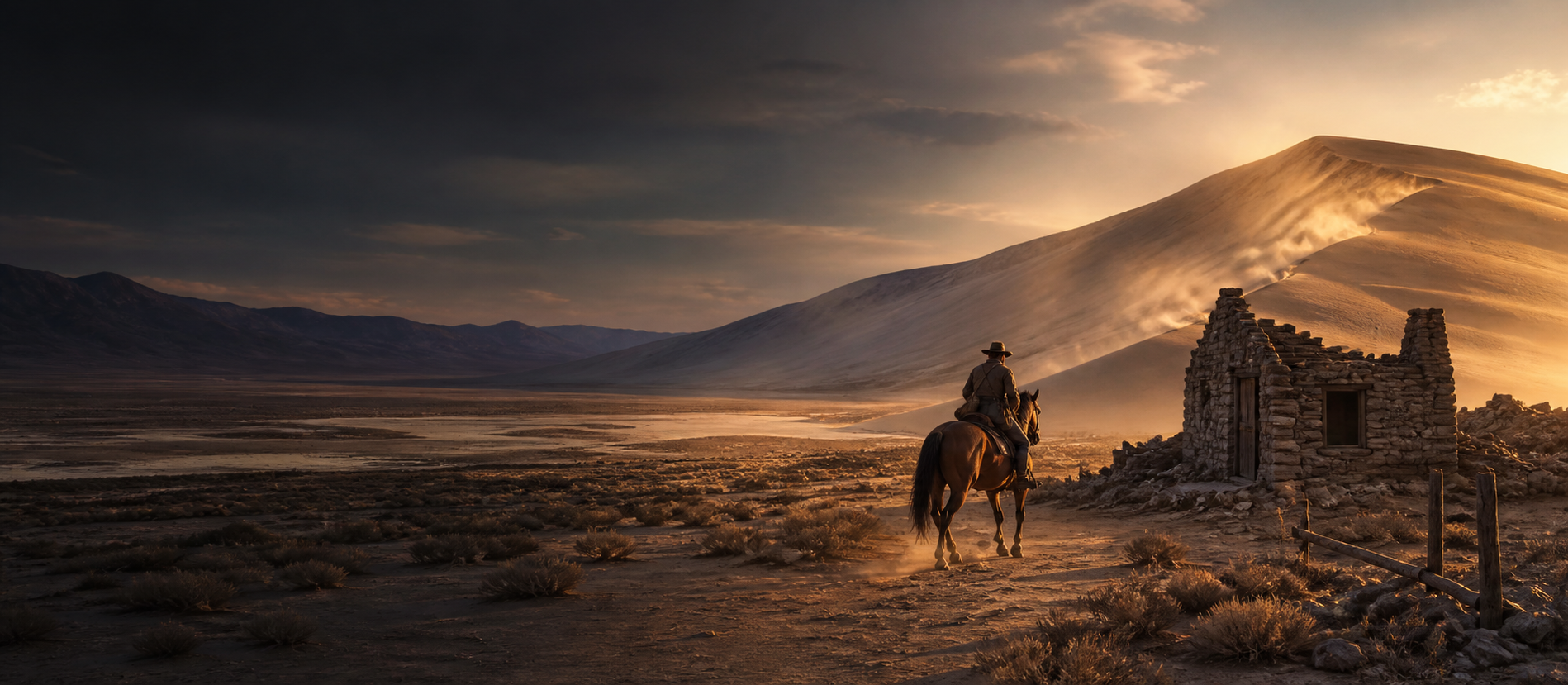
Historical interpretation of a Pony Express rider crossing the Sand Mountain landscape near the Sand Springs station

A mountain left by an ancient lake

Sand that sings. Stories that traveled west.

Sand Mountain is what a dried up inland sea left behind, and the wind is still delivering it. A Pony Express station stood at the foot of the dune for eighteen months. The sand buried it so completely that nobody found it again for more than a century.

The historical scenes on this page are interpretation. The butterfly is a documentary photograph and is credited.
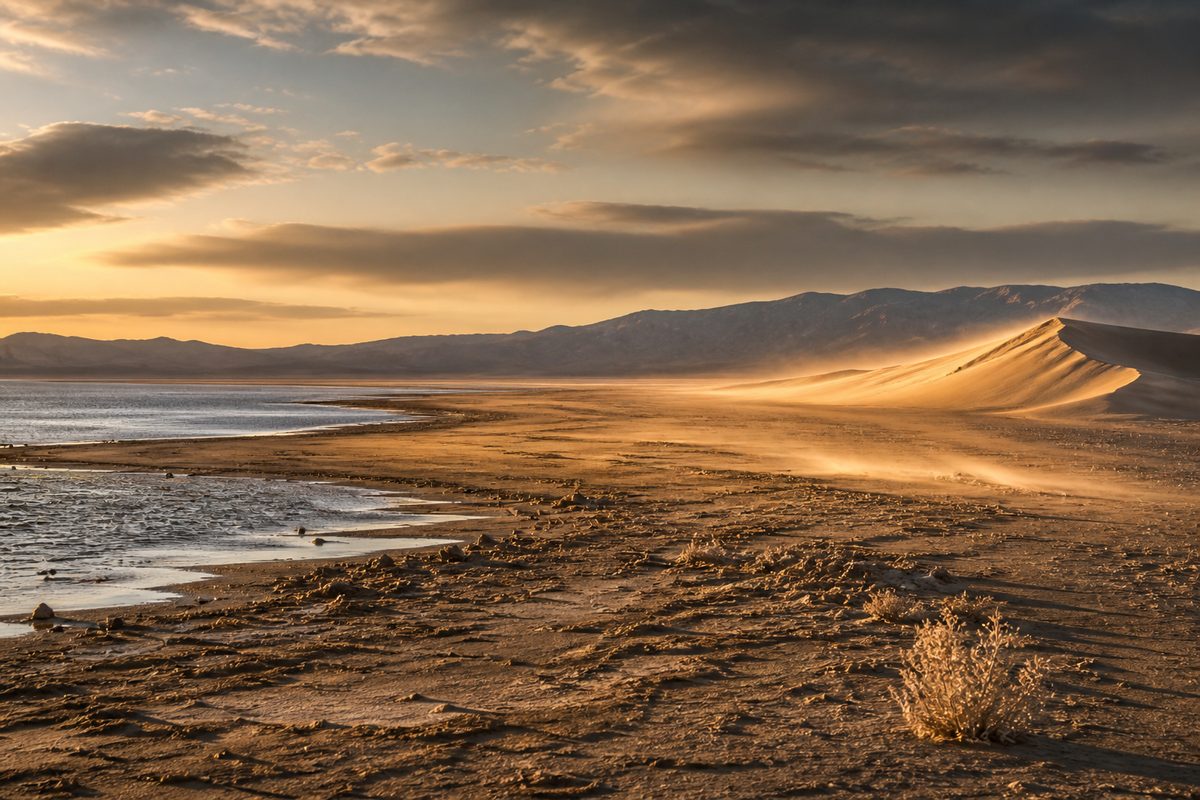
Ancient Lake Lahontan receding from the Nevada basin, exposing the lake bed sand that would later build Sand Mountain
Historical interpretation of Lake Lahontan receding. Not a documentary photograph.

A lake the size of a small sea

Around 8,500 square miles of what is now Nevada sat under water during the last Ice Age. Geologists call it Lake Lahontan. It began drying about 9,000 years ago as the Pleistocene ended, and it left its bed behind as loose, fine sand. Everything you ride here was once lake bottom. That is also why the grains are the shape they are, which turns out to matter more than it sounds.
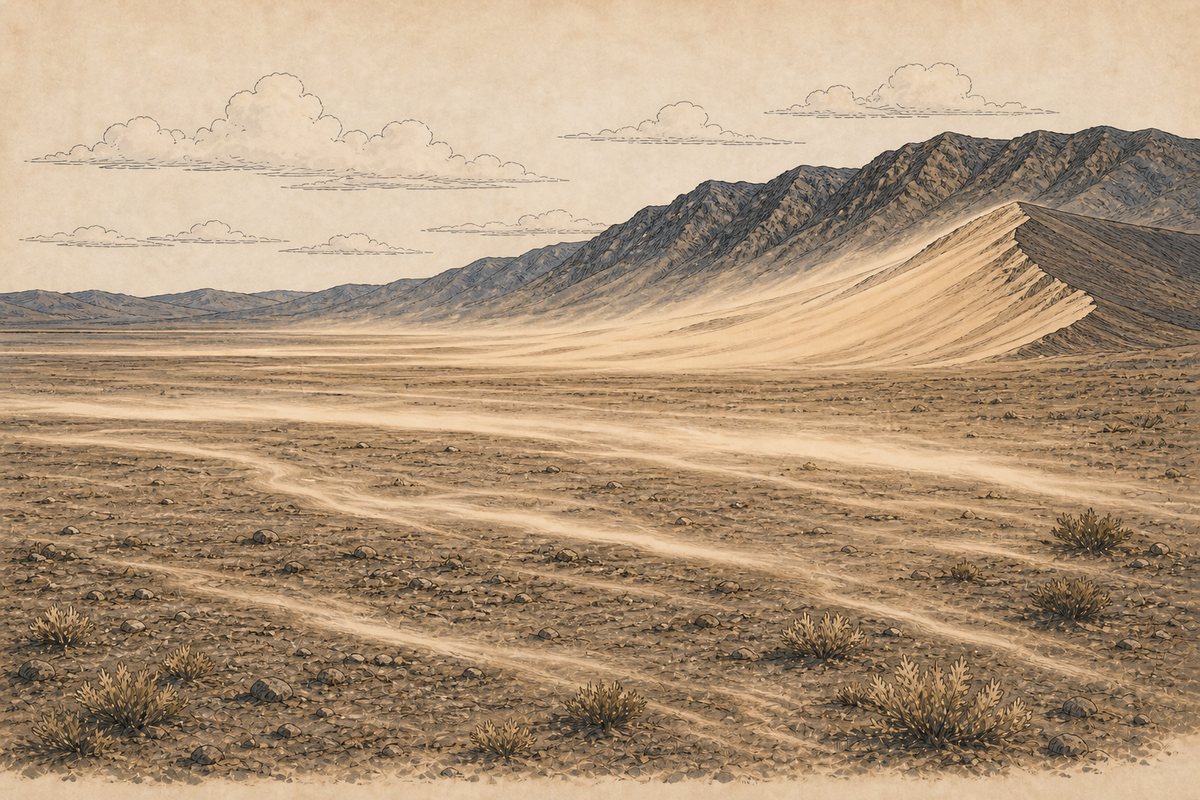
Wind carries pale lake-bed sand across Fourmile Flat and piles it against the Sand Springs Range
Historical interpretation of the continuing movement that builds Sand Mountain.

The dune is still arriving

Sand Mountain is not a leftover. It is a delivery still in progress. Wind keeps moving ancient Lake Lahontan sand through the desert passes and across Fourmile Flat, where it piles against the Sand Springs Range because that is where the wind finally runs out of room. BLM measures the result at 4,795 acres, three and a half miles long, a mile wide, and 600 feet high. It is the largest dune field in this part of Nevada, and it gets a little larger every year you are not looking.

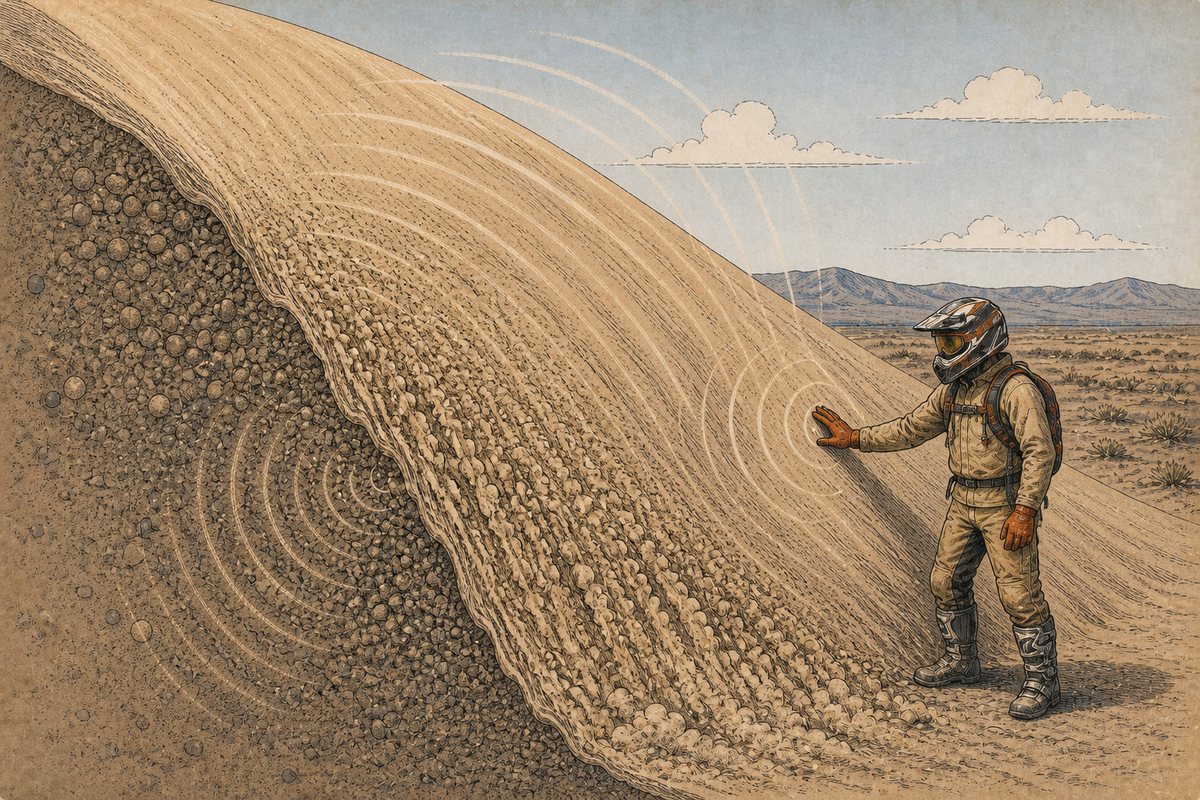
Dry rounded grains cascade together down a Sand Mountain slip face as a rider feels the low vibration
Illustration: synchronized dry sand movement producing Sand Mountain's low rumble.

Why the sand sings

Under the right conditions the dune makes noise. Not wind across a ridge, but a sound coming out of the sand itself. When Sand Mountain grains move together they can produce a low rumble you hear and feel at the same time. Three things have to line up at once: grains of a particular silica composition, grains that are small, dry and round, and a specific level of humidity. Miss any one and the dune stays quiet, which is why it never performs on demand. The National Park Service counts Sand Mountain among only seven known booming dune fields in North America. BLM educational material puts it among roughly 35 singing dunes known worldwide.

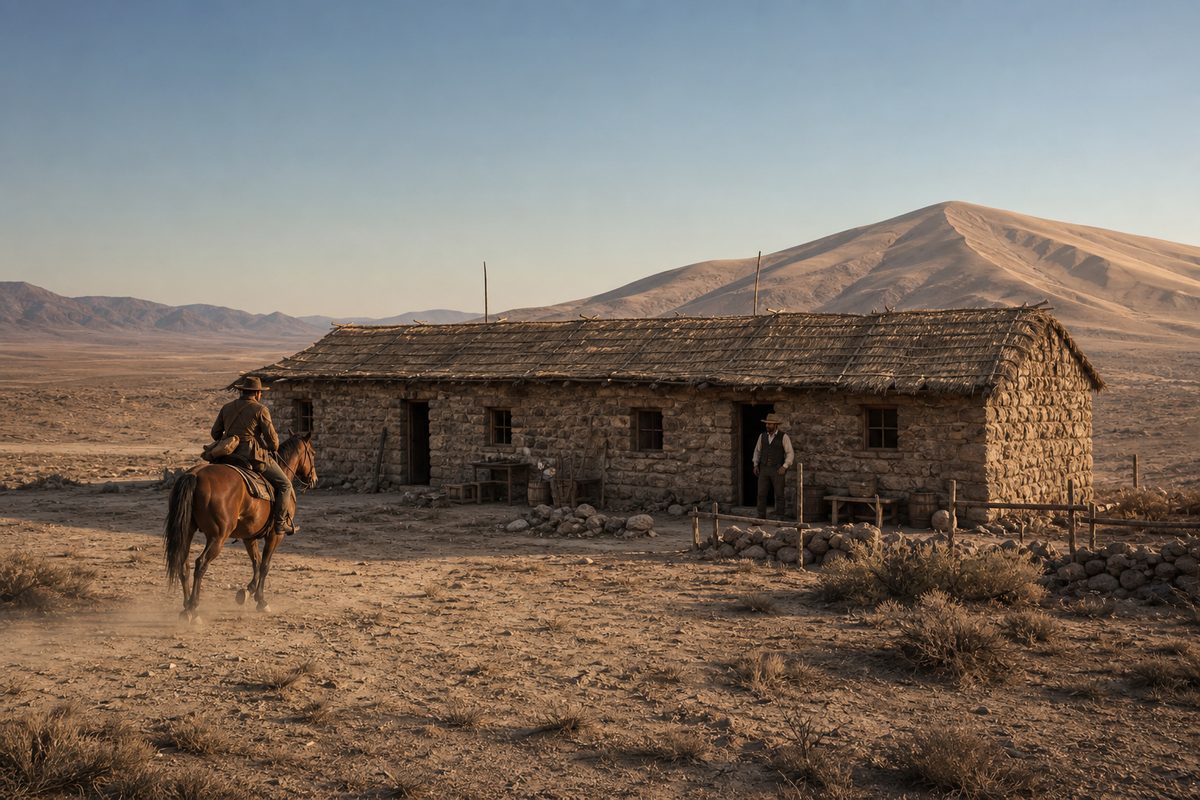
The Sand Springs Pony Express station in 1860, a low six-room building of undressed stone with a thatched willow roof at the foot of the dune
Historical interpretation of the Sand Springs station in 1860. Not a documentary photograph.

Eighteen months of the Pony Express

The station went up in March 1860, built by Bolivar Roberts, J.G. Kelley and a small crew working with what the desert gave them. Six rooms, roughly 102 feet by 56 feet, walls of undressed rhyolite stacked without dressing or mortar work. The roof was thatched willow, because there was no lumber worth hauling this far. James McNaughton kept the station first, then went out and rode the route himself. In November 1861 the transcontinental telegraph connected, and a message that had taken ten days by horse took minutes. The Pony Express was finished. It had run for about eighteen months.

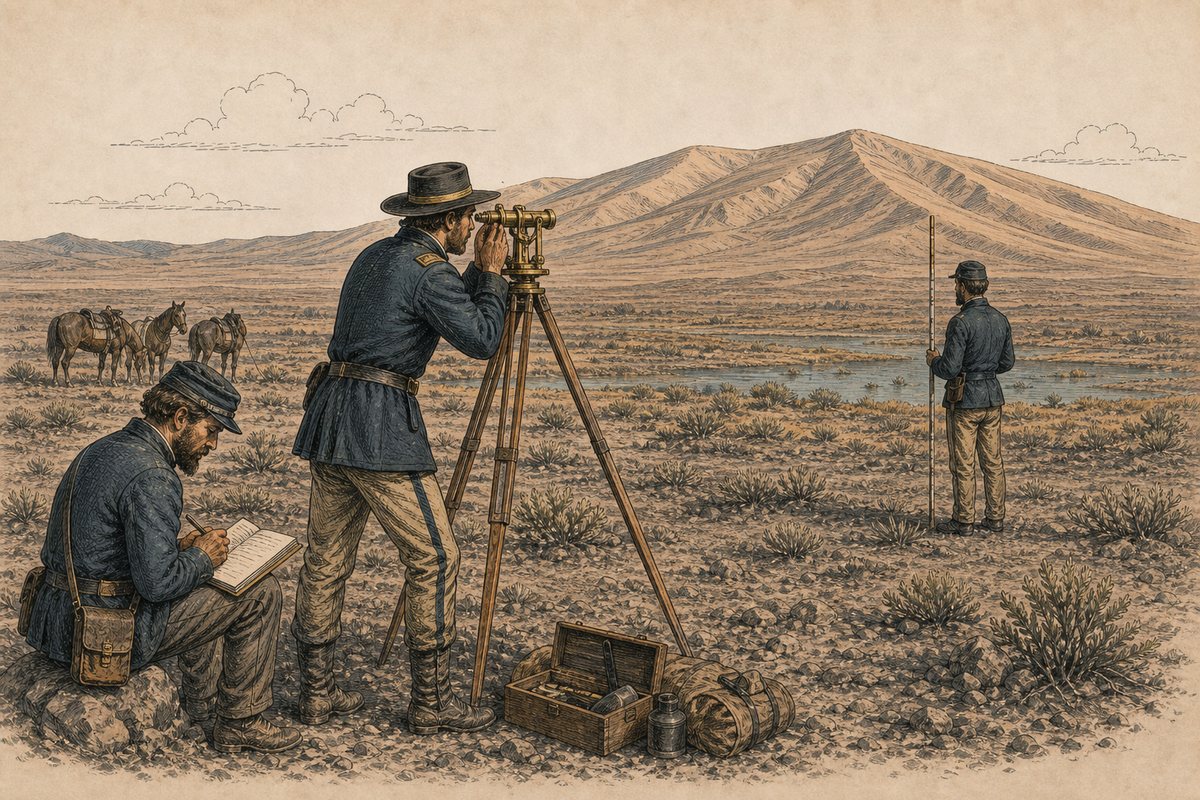
Lieutenant James H. Simpson and assistants survey Sand Springs in 1859 with a brass transit, survey rod and field notebook
Historical interpretation of the 1859 Sand Springs survey.

The surveyor who put it on the map

Army Lieutenant James H. Simpson came through in 1859, surveying Sand Springs as a possible stop for emigrant traffic. That survey is a large part of why anyone built here at all. The place went onto a government map in 1859, held a Pony Express station by the following March, and was under sand within a generation. Simpson's name is still attached to the country around the dune.

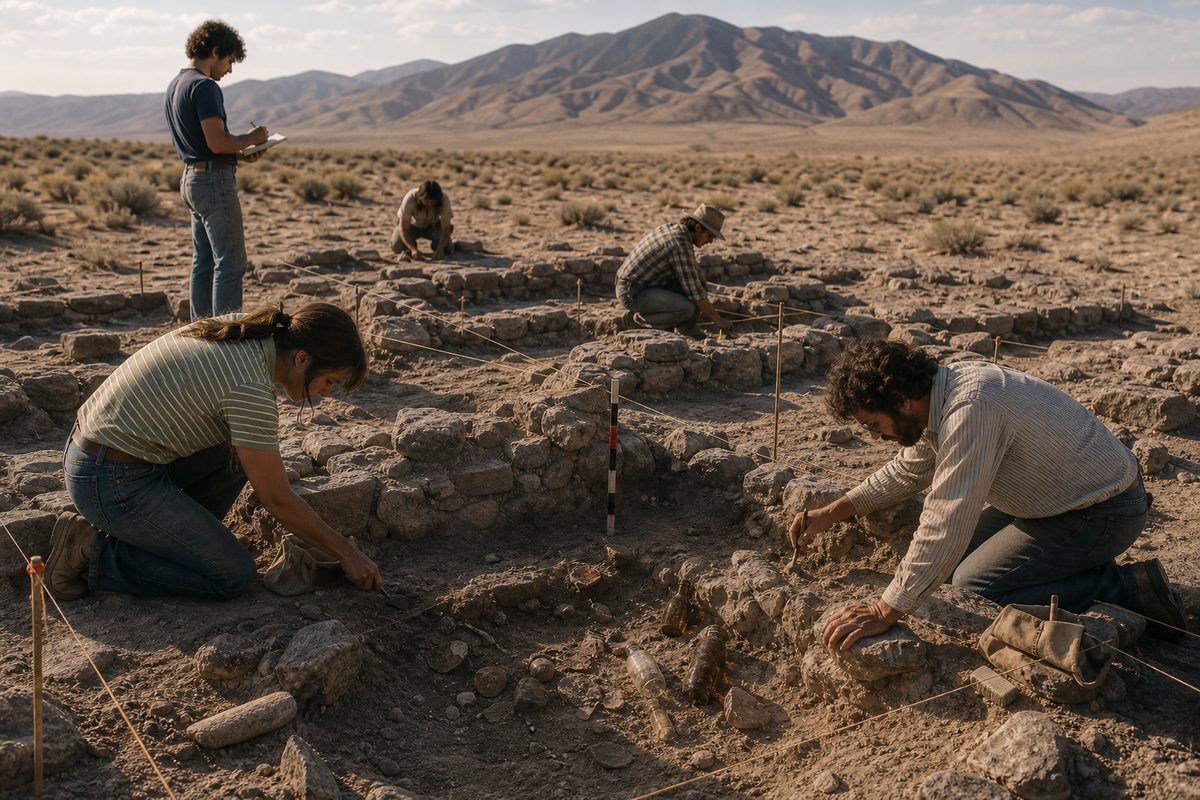
Archaeologists excavating the buried Sand Springs Pony Express station in 1976, clearing sand from the stone walls
Historical interpretation of the 1976 excavation. Not a documentary photograph.

Lost, then found

The telegraph line and the Overland Stage Company kept using the buildings through the 1860s. After that the station simply disappeared. Not abandoned and picked over, but covered. The sand took it, and it stayed gone until 1975, when it was rediscovered. Archaeologists from the University of Nevada, Reno excavated the site the following year and removed what was inside. The single most common thing they pulled out of the sand was broken liquor bottles, which tells you something honest about a remote station in 1860. A careful stabilisation was finished in 1997. The site is on the National Register of Historic Places, and the low stone walls are still there to walk up to.

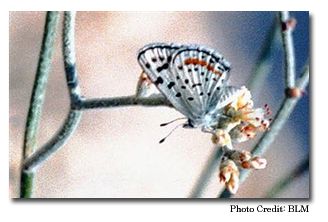
The Sand Mountain blue butterfly, Euphilotes pallescens arenamontana, resting on Kearney buckwheat
Bureau of Land Management photograph, public domain, via Wikimedia Commons. A documentary image, not an interpretation.

A butterfly that lives nowhere else

The Sand Mountain blue, Euphilotes pallescens arenamontana, exists on this dune and nowhere else on Earth. Its caterpillars eat one plant, Kearney buckwheat, and the adults take nectar from the same plant. That buckwheat grows on roughly 1,000 acres inside the recreation area. This is what the signed closures are protecting. They are not arbitrary, and they are not large compared with what is open. Staying out of them is the cheapest thing any rider does all weekend, and it is a large part of why the rest of the mountain stays open to ride.

Verify before travel. Conditions and regulations can change. Use the responsible agency's current information for final decisions.

Open the official BLM source →
Part of theDUNE GUIDE USA NETWORKLocally built dune guides. One place to start.